
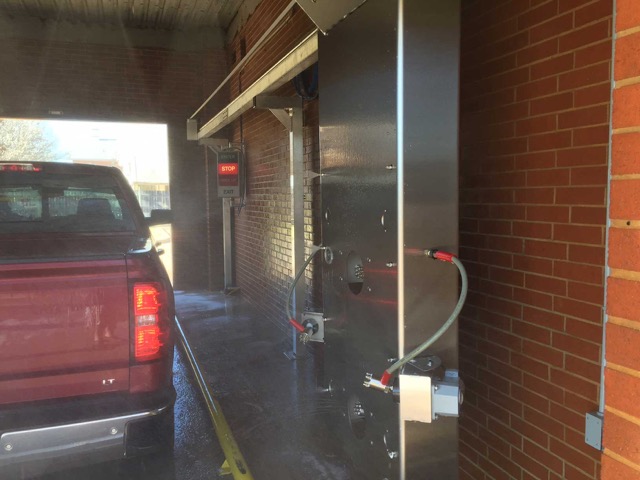
Understanding Water Volume & Water Pressure in Touchless Car Wash Equipment
When it comes to touchless in-bay automatic car wash systems, effective cleaning depends on much more than simply spraying a vehicle with high-pressure water. Water volume and water pressure work together to remove dirt, road grime, chemicals and other contaminants without physically touching the vehicle’s surface. Understanding how these factors interact is an important part of evaluating in-bay automatic car wash requirements and choosing the right touchless car wash equipment for your operation.
Touchless automatic car wash systems can vary significantly in performance, reliability and efficiency. Pump design, nozzle configuration, water delivery methods, chemical application and system controls all influence how effectively a wash removes contaminants. The goal is not simply to use the most water or the highest pressure possible. Instead, an effective system must deliver the right combination of volume, pressure, coverage and cleaning time.
Understanding Water Volume
A fundamental principle in touchless car washing is that volume moves mass.
Water volume provides the flow needed to physically move dirt, debris and cleaning chemicals away from a vehicle’s surface. Even when a system produces substantial pressure, inadequate water volume can limit its ability to rinse contaminants away effectively.
Think of water volume as the amount of cleaning and rinsing power being delivered across the vehicle. If there is not enough water flowing through the system, contaminants may remain on the surface after the wash cycle.
However, more water is not automatically better.
Excessive water volume can increase water consumption, place additional demands on drainage systems and create more water that must eventually be removed during the drying process. The objective is to provide enough water volume to accomplish the cleaning task efficiently without unnecessary resource consumption.
This balance is one of the most important considerations when evaluating in-bay automatic car wash requirements. The system needs to deliver adequate flow for its pump, nozzle and spray configuration while maintaining consistent performance throughout the wash cycle.
Understanding Water Pressure

Water pressure is another critical component of touchless cleaning.
Pressure provides the force that helps separate and remove contaminants from the vehicle. Combined with appropriate cleaning chemicals and sufficient dwell time, high-pressure water can effectively address difficult road film, mud, grime and other debris.
But maximum pressure is not necessarily the goal.
Too little pressure may result in inadequate cleaning, particularly when a vehicle has heavy contamination. On the other hand, excessive pressure can potentially damage sensitive finishes, force water into vulnerable areas or affect protective coatings and components.
The best touchless car wash equipment is engineered to deliver appropriate pressure for the application rather than simply maximizing PSI.
This is why system design matters. Pumps, plumbing, nozzles, spray patterns, distance from the vehicle and the movement of the equipment all contribute to the cleaning result.
Water Volume & Pressure Must Work Together
Water volume and water pressure should not be viewed as separate specifications. They work together to determine the overall effectiveness of a touchless wash.
A system may have high pressure, but if it does not deliver sufficient volume, its cleaning performance can be limited. Likewise, a system may move a significant amount of water, but without adequate pressure and properly designed spray patterns, the water may not have enough cleaning force.
The relationship between these two factors is why evaluating in-bay automatic car wash requirements involves looking at the complete system rather than focusing on one specification.
An effective touchless system should provide:
- Consistent water volume
- Appropriate water pressure
- Proper nozzle selection
- Effective spray coverage
- Reliable chemical application
- Adequate chemical dwell time
- Consistent equipment movement
- Efficient rinsing
- Effective drying
When these elements are engineered to work together, the result is a more consistent and efficient wash.
Learn More About Proper Vehicle Washing
Water volume and pressure are only part of the equation. Learn more about the fundamentals of proper vehicle washing in our blog, “How to Wash a Vehicle Properly.”
Water Shear & Other Considerations
| Metric | Description |
| HPSDC |
High Pressure Spray Density Coverage Density of individual high-pressure spray-jet contacts delivered to a defined vehicle-surface area during gantry travel. |
| CPD |
Contact Point Density Measures how frequently separate (discrete) contact events occur per unit area. |
| FCTD |
Fluid Contact Time Density Measures cumulative contact time per unit area. |
| MCD |
Measures Fluid Contact Time (Duration) Average duration of a contact event. |
| NIC |
Normal Impact Component Component of spray / momentum impact directed normal to the vehicle surface. |
| TIC / Shear Force |
Tangential / Shearing Impact Component Represents a different physical cleaning mechanism on the vehicle surface from normal impact. |
| Force Density | Component of spray momentum / impact is being directed at the vehicle surface. |
| NFD |
Normal Force Density How much of the normal force density is a direct hit on the vehicle surface. |
| TFD |
Tangential Force Density How much of the force density is tangential to the vehicle surface. |
| Impact-Angle Effect | The angle in which the volume and pressure are applied, commonly referred to as the “shear effect”. |
| Multi-Directional Orbital Attack |
A mechanical efficiency when cleaning a surface from multiple angles with shear effect. |
| Peeling / Undercutting Potential |
A mechanical attribute of cleaning enhanced by shear effect. |
| Cumulative NIC Impulse |
The total calculated component of spray momentum / impact directed normal to the vehicle surface. |
| Cumulative TIC Impulse |
The total calculated component of spray momentum / impact directed tangentially along the vehicle surface, representing a different physical cleaning mechanism from normal impact. |
| VCTD |
Volumetric Coverage Thermal Density The volumetric density of fluid over an established area of coverage. |
Nozzle Selection Makes a Difference
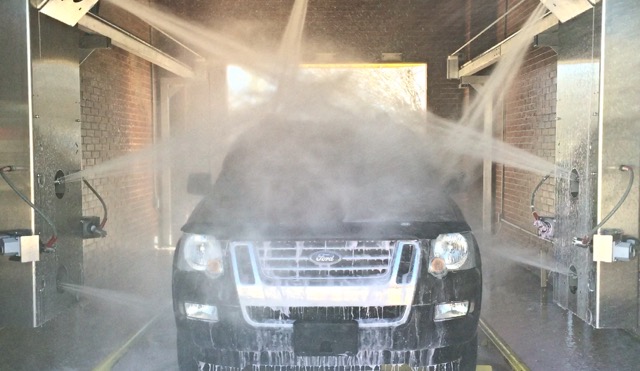
Nozzles play a major role in determining how water is delivered to a vehicle.
For example, a 0-degree nozzle produces a highly concentrated stream of water. This focused spray pattern can provide substantial cleaning force in a specific area and can be useful for difficult contamination or confined areas. However, because the water is concentrated, improper use can increase the risk of surface damage. By properly utilizing the mechanical efficiencies of the shear component, you can greatly enhance overall cleaning efficiency, often using less volume and less pressure.
A nozzle angled at 5, 15, 20, 25 or 40 degrees distributes water across a wider area.
- Bigger coverage: The broad spray pattern covers more surface space at once.
- Lower intensity: It reduces the water pressure at any single point.
No single car wash nozzle works best for every job. Each type has a distinct advantage depending on the application.
- Broad spray patterns at low pressure are best for applying soap and detergent.
- 0-degree nozzles deliver high pressure and concentrated force for tough spots.
Safe angles matter with 0-degree nozzles. The highly concentrated stream of water should be held at a safe angle to avoid damaging the vehicle’s surface.
The appropriate nozzle depends on the system’s pressure, flow rate, distance from the vehicle, angle of attack, movement speed and intended cleaning application. Nozzle configuration must be considered as part of the entire touchless car wash equipment design.
Understanding Cleaning Power & Nozzle Selection
Within the pressure-washing industry, cleaning performance is sometimes evaluated using measurements that combine pressure and flow to estimate the overall cleaning power being delivered.
However, simply increasing the volume and/or pressure or any combination of the two does not automatically produce a better automatic car wash.
An effective system must also consider:
- Surface sensitivity
- Spray coverage
- Angular contact mechanics
- Wash uniformity
- Vehicle size and shape
- Nozzle configuration
- Equipment movement
- Cycle time
- Chemical performance
- Water consumption
A concentrated spray pattern can provide significant cleaning force, but a fixed spray pattern may not provide the coverage needed to efficiently clean an entire vehicle. A straight pattern simply cannot reach areas that are not perpendicular to the nozzle.
A broader spray pattern can provide faster and more uniform coverage, but the system still needs enough pressure and volume to effectively remove contaminants.
The best solution is a carefully engineered combination of water volume, pressure, shear and duration of time spent on any specific point. Combining both direct and tangential cleaning capabilities maximize the effectiveness of the system.
Rotating & Oscillating Nozzles Improve Coverage
One of the major advantages of advanced touchless technology is the use of moving nozzle assemblies.
Fixed nozzles typically direct water from one position and one angle. Moving nozzle systems can approach different areas of the vehicle from multiple directions.
This is particularly important because vehicles are not flat surfaces. They have grilles, bumpers, mirrors, body contours, wheel areas, windows and other complex shapes that can be difficult to clean with a single spray direction.
Rotating or oscillating nozzles can improve coverage by changing the angle and position of the water stream as the equipment moves.
Instead of relying on one straight pass, a properly engineered moving nozzle system can treat different sections of the vehicle from multiple directions. This can help remove stubborn contaminants while creating more consistent coverage across the vehicle.
An Advanced Approach to Focused Nozzles
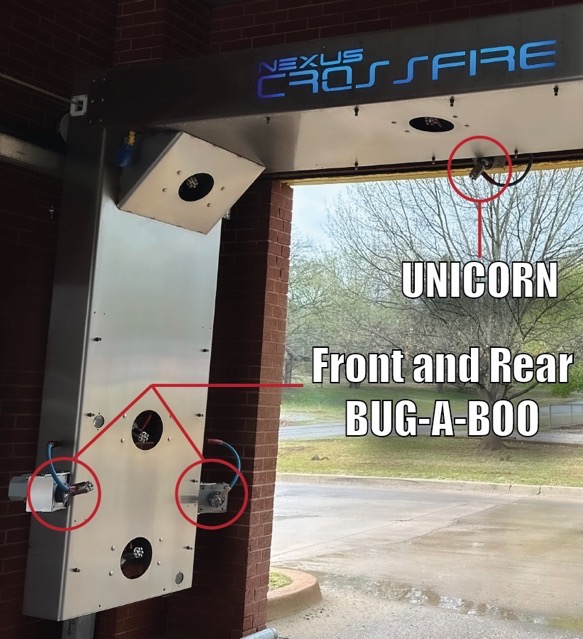
Modern touchless systems can take nozzle technology even further.
One advanced approach uses multiple 0-degree nozzles, strategically angled and articulated within a synchronized, 360-degree rotating assembly, such as the patented F5 Orbital Nozzle by 3B Industries. Rather than relying on a stationary, concentrated jet, the continuously moving nozzles sweep across the vehicle, delivering a combination of water volume, pressure and shear force across the surface.
For example, a synchronized assembly operating at approximately 115 RPM and a coverage speed of around 60 feet per minute can provide extensive, dynamic coverage throughout the wash.
The advantage isn’t simply the number of nozzles or their spray angle. It’s the overall architecture of the system. By continuously moving concentrated water streams across the vehicle from multiple positions and angles, the system creates more coverage, increases the number of contact points and enhances shear mechanics.
This type of engineering demonstrates why evaluating touchless car wash equipment requires looking beyond individual specifications.
How Chemical Application Works With Water
Water pressure and volume are only part of the cleaning equation. Chemicals also play a critical role.
Pre-soaks and detergents help break the bond between contaminants and the vehicle’s surface. Once the chemistry has had sufficient time to work, water volume, pressure and shear can help remove the loosened contamination.
This is why time is another important part of touchless cleaning.
If chemicals are applied and immediately rinsed away, they may not have enough time to perform their intended function. Proper equipment allows operators to configure wash functions, chemical applications and dwell times to maximize this portion of the wash.
Advanced controls can also help maintain consistent chemical ratios and application to the vehicle surface.
The result is a coordinated cleaning process rather than simply spraying more water at the vehicle.
Why System Design Matters When Choosing Touchless Car Wash Equipment
When comparing touchless car wash equipment, it can be tempting to focus on individual numbers such as PSI, GPM or the number of nozzles.
Those specifications matter, but they do not tell the entire story.
Two systems can have similar pressure ratings and still produce very different cleaning results because of differences in nozzle placement, equipment movement, spray coverage, pump performance, chemical delivery and controls.
A well-designed system should balance:
Water Volume + Water Pressure + Application Temperature + Nozzle Configuration + Shear Mechanics + Chemistry + Time = Effective Touchless Cleaning
This holistic approach helps explain why some automatic car wash systems consistently outperform others.
The Crossfire Approach to Touchless Cleaning

The Crossfire from 3B Industries demonstrates how advanced engineering can bring these principles together.
The Crossfire uses multi-angle nozzle arrays designed to maximize surface coverage, increase points of contact, enhance shear mechanics and reach areas that conventional cleaning approaches can struggle to access. Its patented F5 orbital technology uses coordinated nozzle design and movement to create extensive cleaning coverage while maintaining controlled delivery.
Rather than depending on a single stationary spray pattern, the system’s moving nozzle technology helps address complex vehicle contours from multiple directions.
This approach is particularly valuable for businesses that need to clean a wide range of vehicles. Trucks, service vehicles, vans, RVs and other larger vehicles can present cleaning challenges that require more than a basic spray pattern.
The Crossfire’s advanced engineering is designed to provide thorough coverage while maintaining efficient wash cycles. By precisely controlling volume, pressure and shear mechanics alongside the system’s automation control variables, it raises the standard for the touchless car wash industry.
Such innovation sets a new standard for in-bay automatic car wash requirements.
What to Look for in Touchless Car Wash Equipment
When selecting equipment for a new installation or replacing an existing automatic car wash system, consider more than maximum PSI.
Look for a system that provides:
Consistent Water Volume
The system should deliver sufficient flow to effectively remove dirt, debris and cleaning chemicals from the vehicle.
Appropriate Water Pressure
Pressure should provide effective cleaning without increasing the risk to vehicle finishes or components.
Proper Nozzle Configuration
Nozzles should be positioned to provide effective coverage for the types of vehicles the system will wash.
Moving Spray Technology
Rotating or oscillating nozzle systems can provide coverage from multiple angles and improve cleaning consistency.
Reliable Chemical Delivery
The system should provide consistent application of pre-soaks, detergents and other cleaning products.
Efficient Drying
An effective wash must also remove water efficiently. Strong drying performance helps reduce residual water.
Intelligent Controls
Advanced controls can help operators manage pressure, chemical concentrations, wash functions, timing and equipment movement.
Easy Maintenance
Equipment should be designed for straightforward maintenance, reliable operation and minimal unnecessary downtime.
Finding the Right Balance
The best touchless automatic car wash is not necessarily the system with the highest pressure or the greatest water volume. Instead, it is the system that effectively balances water volume, water pressure, shear mechanics, chemistry, nozzle technology, movement and time.
Understanding this balance can help car wash owners make better equipment decisions and establish realistic in-bay automatic car wash requirements for their location.
Modern touchless technology continues to demonstrate that cleaning performance comes from engineering the entire process — not simply increasing PSI.
When water volume provides the flow needed to move contaminants, pressure provides the necessary cleaning force, shear supplies multiplied mechanics, chemicals loosen difficult grime and advanced nozzle movement provides thorough coverage, a touchless system can deliver powerful cleaning without physically contacting the vehicle.
For car wash owners looking for touchless car wash equipment, that balance is what can turn a basic automatic wash into a high-performance cleaning system.
Find the Right Touchless Car Wash Equipment
3B Industries can help you find a system engineered around the needs of your car wash operation. Contact 3B Industries today to discuss your equipment needs and find the right solution for your business.
Frequently Asked Questions
How much water pressure does a touchless car wash need?
The appropriate water pressure depends on the equipment’s design, nozzle configuration, vehicle types and cleaning process. A higher PSI rating does not necessarily mean better cleaning. The system should balance pressure with water volume, shear mechanics, nozzle movement and chemical application.
Why is water volume important in a touchless car wash?
Water volume provides the flow necessary to move dirt, debris and cleaning chemicals away from the vehicle. Insufficient volume can reduce a system’s ability to remove heavy soils, and reduce rinsing effectiveness, while excessive volume can increase water consumption and create additional drainage and drying demands.
What is the difference between a 0-degree nozzle and a 5, 15, 20 or 25-degree nozzle?
A 0-degree nozzle produces a highly concentrated water stream, while 5, 15, 20 or 25-degree nozzles create broader spray patterns. A 0-degree nozzle can provide focused cleaning power, while a wider-angle nozzle can provide more uniform coverage with less concentrated force.
What should I consider when choosing touchless car wash equipment?
Consider water volume, pressure, shear mechanics, nozzle configuration, equipment movement, chemical delivery, wash cycle times, vehicle capacity, drying performance, maintenance requirements and overall system reliability. Looking at the entire system is more useful than comparing a single specification.
What are the most important in-bay automatic car wash requirements?
Requirements vary by location and equipment, but important considerations include adequate water supply, drainage, electrical service, chemical systems, equipment clearance, vehicle capacity and the water volume, water pressure and shear mechanics supplied by the selected system. Equipment specifications should be reviewed before installation.