
Introduction
Building a car wash means more than picking equipment and pouring a slab. It's a coordinated sequence: market research, site due diligence, financing, permitting, design, construction, equipment installation, and launch prep. Skip a step, and it usually costs more later.
Many first-time owners treat "build a car wash" as shorthand for "buy a wash machine." That's a costly assumption.
The U.S. car wash and auto detailing industry is projected to generate $17.0 billion in revenue across roughly 16,745 businesses in 2026, according to IBISWorld's industry analysis. In a market that crowded, sequencing—not just equipment—decides who succeeds.
This guide walks through the full build process: feasibility, site selection, financing, design, permitting, construction, and commissioning. It also covers when building new isn't the smarter move.
Key Takeaways
- Feasibility research and business-model selection come before equipment shopping, not after
- Zoning, utilities, drainage, and traffic access can stop a project before construction starts
- Your wash format (self-service, in-bay automatic, tunnel, or fleet) dictates design, staffing, and capital needs
- Financial models need current supplier and contractor quotes, not generic online averages
- Commissioning and staff training before opening day prevent expensive early breakdowns
What Is the Car Wash Building Process?
The car wash building process is the sequence of decisions that turns a business concept into an operating facility. It starts with feasibility research and ends with a permitted, properly designed site that can serve customers safely and repeatedly.
The intended outcome is practical: a legally approved location, built to the right specifications, equipped to handle expected demand without constant breakdowns.
New Build vs. Buying or Leasing
Not every path to ownership requires ground-up construction. Each option carries different risk and timeline:
- Building new offers full control over layout and equipment but carries the longest timeline and highest upfront risk
- Buying an existing wash shortens the timeline and often includes an established customer base, though equipment condition and site limitations may need correcting
- Leasing space for a wash operation reduces land costs but limits design flexibility
- Adding equipment to an existing site (a convenience store or gas station, for example) is the fastest path but depends on existing utility and space capacity
How the Steps Connect
The process runs in a logical chain. Each stage feeds the next:
- Define the concept and validate demand
- Select and investigate a site
- Build the financing plan and secure approvals
- Design and construct the facility
- Install equipment, test systems, then launch and refine
Key inputs feed every stage:
- Target customers and local competition
- Traffic data and zoning rules
- Utility availability, water, and wastewater requirements
- Available capital
A business idea becomes a permitted physical site, then an integrated system that delivers a consistent customer experience. Outcomes hinge on the details: budget contingencies, engineering reviews, contractor coordination, and pre-opening testing.

The 6-Step Process to Build a Car Wash
Step 1: Define the Business Model and Test Feasibility
Your wash format determines almost everything downstream: site size, equipment complexity, staffing, and capital needs.
| Format | What Drives Capital Needs | Staffing and Operations |
|---|---|---|
| Self-service | Number of bays, per-bay equipment, payment systems | Mostly unattended; routine cleaning and maintenance |
| In-bay automatic | Automatic machine, bay size and clearance, water treatment | Light staffing; equipment monitoring and upkeep |
| Touchless in-bay automatic | Touchless machine, chemical delivery, reclaim and spot-free systems | Light staffing; chemistry and water quality checks |
| Tunnel/express | Conveyor length, building footprint, queue lanes, dryers | Attendants at entry and peak-hour staffing |
| Fleet/large-vehicle | Acreage, bay count, oversized clearance, heavy-duty equipment | Scheduled fleet volume; trained operators |
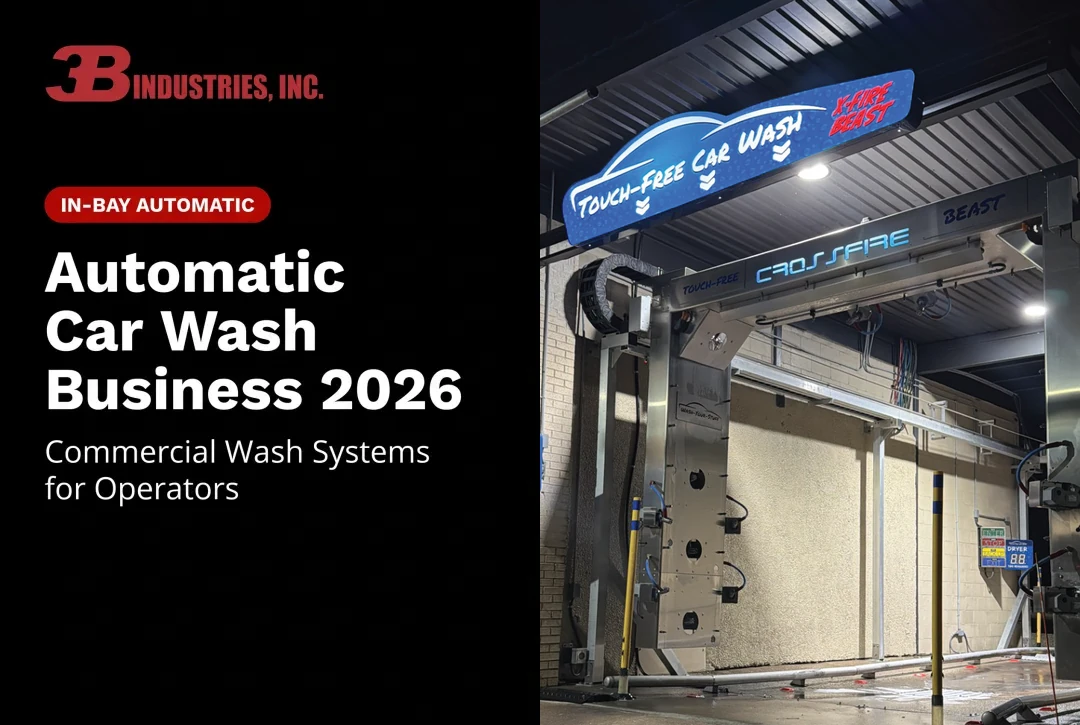
Land, construction, and utility costs vary too widely by location for a national average to be useful. Equipment is the most predictable line: for a touchless in-bay automatic, 3B Industries' American-made systems are estimated at $188,000 (Crossfire), $205,000 (Crossfire+), $235,000 (Beast), and $252,000 (Crossfire XL), equipment only. These are estimates, since component and metal prices can change by the time of purchase. Price the rest of the project with site-specific quotes from contractors, engineers, and utility providers.
Before committing to a format, run a feasibility review covering:
- Local demand and competitor density
- Traffic patterns and expected car count
- Pricing structure and revenue streams (memberships, add-ons, fleet contracts)
- Break-even volume and a conservative downside scenario
Demand context matters here too. Per ICA's Q4 2024 Pulse survey, 73% of Americans say a car wash is where they most often get their vehicle cleaned. That figure is encouraging for the industry overall, but it says nothing about whether your specific site will capture that traffic.
Step 2: Select and Investigate the Site
A site isn't viable just because it's on a busy road. Verify that traffic can actually enter, queue, wash, exit, and merge safely back into surrounding roads.
Assess these factors before signing anything:
- Visibility, ingress/egress, and turning movements
- Lot size, shape, grading, and drainage
- Flood risk and environmental conditions
- Zoning, conditional-use requirements, and setbacks
- Water supply, sewer capacity, and wastewater discharge rules
- Signage restrictions and required access approvals
A site that fails on queue capacity or drainage can quietly sink a project long before the first customer arrives.
Step 3: Build the Business Plan, Budget, and Financing Package
Separate one-time development costs from ongoing operating costs in your financial model.
One-time development costs typically include:
- Land or lease costs and site preparation
- Building, paving, and utility work
- Water treatment and reclaim systems
- Wash equipment, payment systems, vacuums, and signage
- Professional fees, permits, insurance, and contingency
Ongoing operating costs typically include:
- Labor, chemicals, and utilities
- Maintenance, repairs, and payment processing fees
- Insurance, marketing, and debt service
Get current quotes from equipment manufacturers, contractors, engineers, and utility providers. Online estimates are useful for early planning, but they're not guaranteed project prices.
Your financial model should produce sources and uses, monthly cash flow, a break-even car count, sensitivity analysis, and a conservative downside case a lender can stress-test.
Step 4: Design the Site, Building, Utilities, and Customer Flow
Civil, architectural, electrical, plumbing, and equipment plans need to work together, not develop in isolation. A design that looks good on paper can fail if the equipment layout doesn't match the queue flow or the drainage plan doesn't match the grading.
Design decisions to lock down include:
- Bay or tunnel dimensions and queue length
- Payment points, vacuum areas, and employee spaces
- Water softening, filtration, reverse osmosis, and reclaim systems
- Oil/water separation and wastewater handling
- Lighting, accessibility, and weather-specific considerations
This is also the stage where equipment selection should happen: after the concept and layout are set, not before. 3B Industries' site-assessment process works through location evaluation, layout planning, and utility and space requirements before recommending specific equipment. That order keeps design driving the equipment choice rather than the reverse.
Step 5: Secure Approvals and Complete Construction
Approvals typically follow this sequence:
- Land-use confirmation and preliminary site review
- Engineering and architectural plan submission
- Utility and environmental reviews
- Building and trade permits
- Signage approvals and inspections
- Final occupancy or operating approval
Construction then moves through clearing, grading, drainage, underground utilities, foundations, building work, paving, and finishing. Document scope, schedule, allowances, exclusions, payment milestones, and warranty terms with your general contractor before work starts. Change orders get expensive fast without a clear baseline.

Step 6: Install Equipment, Commission Systems, and Prepare to Open
Installation covers pumps, arches or gantries, conveyors where applicable, pay stations, dryers, vacuums, chemical delivery, water treatment, cameras, and point-of-sale technology.
Once installed, commission everything before you open:
- Water pressure and chemical dilution
- Payment processing and equipment sequencing
- Emergency stops and drainage performance
- Wash quality, drying, and queue movement
For in-bay automatic setups, 3B Industries' Crossfire (offering express cycles in as little as 1 minute, 19 seconds) need bridge clearance and cycle-time verification before launch. Self-service bays running an Omni II-type system need payment hardware and pressure-tier testing.
Train staff on chemical handling, equipment checks, cleaning routines, and incident response before the doors open. A controlled soft opening (running the wash for a limited group before full marketing) surfaces bottlenecks while the stakes are still low.
Where the Process Applies and What Affects It
The core sequence stays the same across formats, but the emphasis shifts:
- Self-service sites focus on bay count, payment systems, and unattended operations
- In-bay automatic sites focus on vehicle positioning, bay clearance, and payment flow
- Tunnel/express sites need detailed conveyor, queue, and drying planning for high throughput
- Fleet/large-vehicle facilities require oversized clearances, heavy-duty equipment, and safety procedures for large rigs
The process also applies beyond a first build. Expansions, conversions of existing facilities, equipment replacements, and major renovations all follow a similar path.
Variables that most affect outcomes:
- Land conditions and local regulations
- Water source, quality, and wastewater rules
- Climate and utility capacity
- Financing terms and labor availability
- Construction market conditions and equipment lead times
Stop-and-redesign checklist: Reconsider the project if you find:
- Inadequate site access or queue space
- Zoning that can't accommodate the wash format
- Water restrictions the reclaim system can't offset
- A financial model that fails under conservative assumptions
Common Issues, Misconceptions, and When to Reconsider
A busy road doesn't guarantee a busy wash. Visibility matters, but so does whether customers can actually get in and out, how you compare to nearby competitors, and whether your pricing brings people back.
Equipment price is only one line in the budget. Land, construction, utilities, permitting, water systems, professional fees, and working capital can shift total investment substantially — sometimes double what a first-time owner expected.
Common process failures include:
- Buying land before completing due diligence
- Selecting equipment before finalizing the design
- Underestimating wastewater or utility requirements
- Skipping contingency funds
- Opening without trained staff or maintenance procedures
Building new may not be the right move when:
- Demand is unproven
- Approvals look unlikely
- Site constraints are severe
- The downside financial case can't cover debt service
In those situations, buying and upgrading an existing wash often carries a better risk-adjusted return.

Get independent legal, engineering, and financial advice before committing significant capital. A second opinion is cheap compared to a stalled project.
Conclusion
Building a car wash is a staged process:
- Market validation and site due diligence
- Financial planning and approvals
- Design, construction, and equipment integration
- Operational readiness
Rushing to buy equipment before the site and financial model are validated is the most common and costly mistake.
3B Industries works with prospective and existing operators on demographic analysis, site selection, equipment, installation, chemicals, and custom fabrication. Contact the team to discuss project-specific requirements. Results depend on your site, market, and execution, and no outcome is guaranteed.
Frequently Asked Questions
How much does it cost to build a car wash?
Land and construction costs vary too widely by location to give a reliable range, so price those with site-specific quotes. Equipment is easier to pin down: 3B Industries' touchless in-bay systems are estimated at $188,000 to $252,000 (Crossfire through Crossfire XL), equipment only. These are estimates, since component and metal prices can change by the time of purchase.
Is car washing a profitable business?
Profitability depends on location, pricing, wash quality, throughput, and operating costs. Test conservative car-count and break-even assumptions in your own financial model rather than relying on industry averages.
What is the first step in building a car wash?
Define your business model and complete a feasibility review before purchasing land or equipment. This includes demand research, competitor analysis, site requirements, and initial financial projections.
How long does it take to build a car wash?
Timelines vary widely based on site condition, design complexity, permitting speed, and equipment lead times. Permitting alone can extend a project by several months, so build schedule buffer into your plan.
Which type of car wash is best for a new owner?
No single format fits every owner. Self-service needs less capital and staffing; in-bay and tunnel formats cost more but handle higher volume—match the choice to your land, capital, and desired involvement.
What permits are needed to build a car wash?
Requirements vary by jurisdiction but commonly include zoning or land-use approval, building and trade permits, utility and wastewater approvals, stormwater review, signage approval, and final occupancy sign-off.