
Introduction
Installing a commercial automatic car wash isn't a matter of bolting a machine to the floor and plugging it in. It's a coordinated build involving structural work, electrical service, plumbing, drainage, chemical systems, controls, and safety compliance — all happening at once, on the same site.
Installation typically falls to the equipment manufacturer's technicians, licensed electricians and plumbers, and qualified contractors. Not a weekend DIY project.
Get the install wrong, and problems show up fast:
- Poor wash quality and repeat customer complaints
- Leaks, drainage failures, and damaged equipment
- Unsafe operating conditions and compliance issues
- Extended downtime, expensive rework, and warranty disputes
A bay that is down—or washing badly—costs you cars and trust long before a full rebuild is scheduled.
This guide covers what it takes to install an automatic car wash the right way:
- Site readiness and prerequisites before equipment arrives
- Placement, utility hookups, and system integration
- Commissioning, validation, and early troubleshooting
- When to stop and bring in a specialist
Key Takeaways
- Commercial installs need coordination among the owner, supplier, contractors, and local authorities.
- Confirm bay size, foundation, drainage, utilities, chemical storage, and safety systems before equipment arrives.
- Follow the manufacturer's install sequence for positioning, connections, and programming.
- Don't open to customers until testing, leak checks, and operator training are fully complete.
- Evaluate the total installed project cost, not just the machine's sticker price.
Prerequisites and Safety Considerations
Before any equipment shows up at the loading dock, the site needs to prove itself ready. That means confirming three broad categories: physical readiness, technical compatibility, and regulatory approval.
Site readiness checks include:
- Bay dimensions, ceiling height, and equipment-room space matched to the specific machine model
- Structural capacity and floor condition suited to the equipment's weight and vibration loads
- Vehicle approach and exit path, plus maintenance access for technicians
- Drainage, ventilation, and freeze protection where climate requires it
Compatibility checks include:
- Machine model against vehicle envelope, conveyor, or guide system
- Existing plumbing, water pressure, and flow rate against manufacturer requirements
- Electrical voltage and phase against the control system's specifications
- Payment equipment, water treatment, reclaim systems, and chemical compatibility
Electrical work deserves particular attention. A vehicle wash area is classified as a wet location under the National Fire Protection Association's code framework, meaning conductors and equipment must be rated for damp or wet conditions, not standard indoor fixtures.
Before any servicing or maintenance begins, OSHA's lockout/tagout standard requires documented energy-control procedures, trained personnel, and verified deenergization. The procedure itself must be inspected at least annually. This isn't optional paperwork; it's how technicians avoid getting hurt around pumps, conveyors, and pressurized lines.
Regulatory Readiness You Can't Skip
Permits and approvals vary by state and municipality, but a few categories show up almost everywhere:
- Building permits and electrical/plumbing inspections
- Wastewater discharge approval (some states, like Texas, require a facility permit plus a catch basin or grit trap before connecting to the sewer)
- Chemical handling documentation, including safety data sheets accessible on every shift
- Accessible parking and routes meeting ADA site requirements
Tools and Parts: A Manufacturer-Driven Checklist
Treat the tools and parts list as a checklist tied to your specific equipment manual, not a generic hardware run. Categories typically include:
- Lifting and positioning equipment
- Approved anchors and fasteners
- Electrical disconnects and conduit
- High-pressure piping and drainage components
- Chemical injectors, control wiring, and sensors
Specialized pressure-testing, calibration, and commissioning tools are often required, and substitutes shouldn't be used where they could affect alignment, chemical compatibility, or warranty coverage. Before delivery, verify the bill of materials and separate what ships with the machine from what your contractor needs to supply.
A stop condition here is real: an unsuitable foundation, inadequate electrical capacity, incomplete drainage, or missing manufacturer instructions should halt the project until resolved. A short pre-installation meeting with a written responsibility matrix (who's doing what, and by when) saves far more time than it costs.
How to Install an Automatic Car Washing Machine (Step-by-Step)
Installation complexity depends on the system and the job. In-bay automatic, touchless, and full-tunnel installs each differ, and so do new construction, replacement, and retrofit projects.
The sequence below follows the general order most manufacturer manuals specify. Skipping steps creates alignment problems, sensor faults, and premature wear.
- Confirm the approved layout: dimensions, service clearances, foundation specs, vehicle path, drainage points, and utility connection locations, all before unloading the machine.
- Prepare the installation area: complete concrete work, drainage, trenching, electrical service, ventilation, water treatment, and chemical storage per the project design.
- Receive and inspect the shipment: document any damage, match components against the packing list, and keep manuals and wiring diagrams on hand.
- Position and secure the equipment: verify level, orientation, clearances, and anchoring before final tightening.
- Connect mechanical and fluid systems: water supply, high-pressure lines, drains, chemical feed lines, and filtration, with leak and pressure checks before anything runs.
- Complete electrical and controls integration: disconnects, grounding, control panels, sensors, and emergency stops, handled by qualified personnel only.
- Configure and calibrate: vehicle detection, spray-arm or gantry travel, chemical dosing, and safety interlocks set to manufacturer specification.
- Commission in stages: test individual components first, then run water-only checks, then full wash cycles with a test vehicle and trained staff.

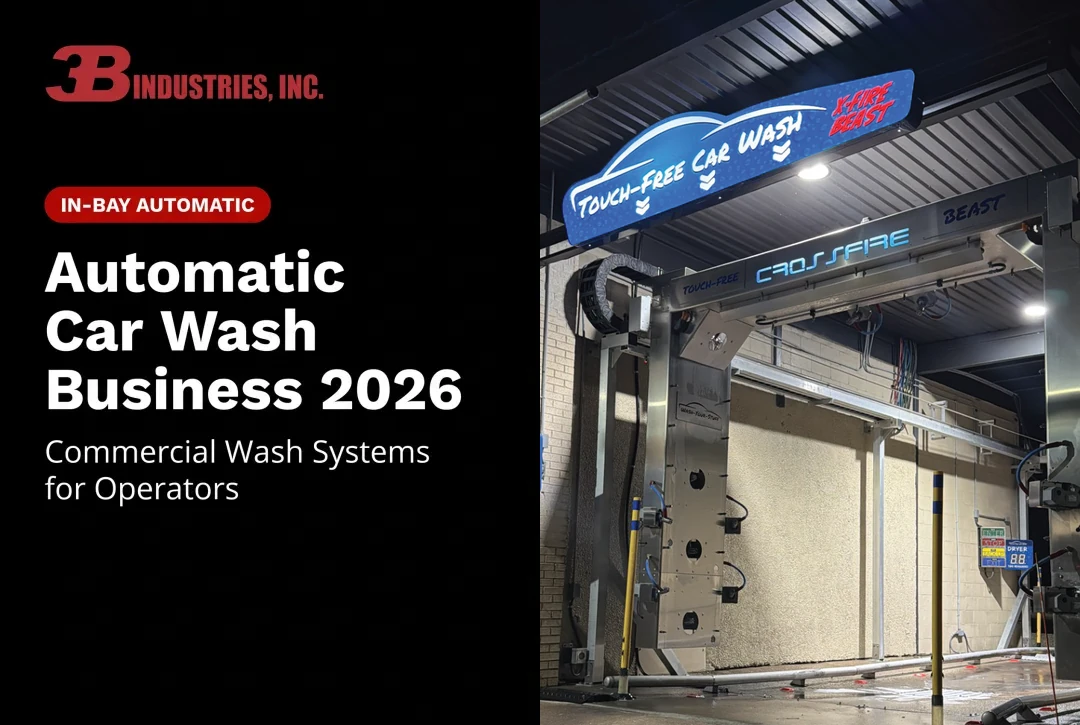
Those steps only hold if the bay matches the machine. Bridge clearance matters more than most first-time buyers expect. 3B Industries' CROSSFIRE family, for example, spans clearances from 8 feet 7 inches on the standard unit up to 14 feet 10 inches on the GAUNTLET model built for tractor-trailers and large mass-transit vehicles. That range shows "automatic car wash" covers a wide set of physical footprints, not one standard bay.
For owners who'd rather not coordinate equipment selection, fabrication, installation, and chemical planning as three separate vendor relationships, an integrated manufacturer such as 3B Industries handles those pieces as connected parts of one project. Confirm the exact scope against your specific site and system.
Post-Installation Checks and Validation
Commissioning is complete only when you have documented proof the installation is safe, functional, and ready for daily operation.
Visual and structural checks:
- Equipment level, anchors secure, clearances unobstructed
- Wiring protected, piping properly supported
- Guards intact, chemical storage safe, no visible leaks
Functional tests:
- Pumps, motors, spray systems, brushes or touchless arms, dryers
- Water reclaim, chemical dosing, and sensor accuracy
- Vehicle positioning, payment controls, emergency stops, and automatic shutdowns
A typical commissioning sequence starts with a visual inspection about 30 minutes before opening, then a dry run with no vehicle, a full test wash with a vehicle, and a walk-through of the tunnel or bay.

Compare results to the manufacturer's specifications on:
- Cleaning coverage and drying quality
- Chemical concentration and cycle timing
- Noise and vibration
Operator Training Isn't Optional
Before the first paying customer pulls in, staff need training on:
- Startup and shutdown procedures
- Daily inspection and chemical handling
- Emergency response and jam clearing
- Basic troubleshooting and escalation procedures
Trained operators still need a clear paper trail. Build a handover package with as-built drawings, manuals, warranties, test results, maintenance schedules, spare-parts lists, utility shutoffs, and support contacts. Skipping this step lets small leaks, calibration errors, or safety faults hide until they become customer complaints or an expensive breakdown.
Common Installation Problems and Fixes
Even well-planned installations run into snags. Here are three that show up most often, along with what usually causes them.
| Issue | Likely Cause | High-Level Fix |
|---|---|---|
| Leaks, weak pressure, or uneven spray coverage | Incorrect pipe sizing, blocked filters, loose fittings, damaged seals, uncalibrated nozzles | Isolate the system safely, inspect filters and connections, pressure-test, and have qualified personnel correct the install |
| Sensor, positioning, or control faults | Misaligned sensors, wiring errors, poor grounding, programming mistakes | Review wiring diagrams, test safety interlocks, remove obstructions, verify programming with the equipment technician |
| Chemical dosing, drainage, or water-treatment problems | Chemical incompatibility, blocked injectors, improper dilution, poor drainage slope | Confirm approved chemical specs and dosing settings, clean injectors, inspect drainage, validate with the supplier |
Water pressure problems are especially common on touchless systems. Most commercial automatic and self-serve systems run between 900 and 1,200 PSI, and a booster pump is sometimes needed when incoming pressure falls short.
On the chemical side, most detergents hit peak potency around 120°F to 125°F. Too much heat breaks the formula down before it ever touches the vehicle.
Drainage problems carry a compliance angle too. Texas wastewater guidance from the TCEQ, for instance, requires facility approval before sewer discharge and a catch basin or grit trap. Rules vary by state but follow a similar pattern almost everywhere. If standing water, odor, or reclaim malfunctions show up after installation, drainage compliance is often the root cause, not just a plumbing nuisance.
When to stop and call the manufacturer: any fault involving safety interlocks, emergency stops, or repeated sensor failures after a wiring check. Bypassing a safety device to keep the line moving is never the fix.
Pro Tips for Installing an Automatic Car Washing Machine Effectively
A few habits separate smooth installations from drawn-out ones:
- Sequence your schedule correctly. Only bring equipment onsite after civil work, utility upgrades, and permits are confirmed. Sensitive controls don't belong on an unfinished or exposed site.
- Keep one project record. Approved drawings, utility requirements, delivery photos, test results, calibration settings, and sign-off documentation all live in a single file, not scattered across email threads.
- Plan for what comes after opening day. Spare parts, preventive maintenance, chemical supply, and a fault-response process should be settled before the ribbon-cutting, not improvised afterward.
- Bring in a specialist for complex scopes. Tunnels, conveyors, major electrical upgrades, new drainage infrastructure, or a retrofit with uncertain existing conditions all warrant dedicated expertise.
Those habits matter more once you see where the money actually goes. One 2025 industry report on tunnel construction described a project with roughly $1 million in equipment alone, against a total installed cost near $4 million. Site work and a 2,400-square-foot building ran nearly $2 million of that figure.
Building shell and foundation costs alone ranged from $260 per square foot in one market to more than $400 on the West Coast. The equipment price tag is rarely the whole story.

3B Industries' site-assessment support, covering location evaluation, layout planning, and utility requirements before equipment ever ships, reflects why that upfront planning phase matters as much as the install itself.
Conclusion
Installation quality shapes everything that follows: wash performance, customer safety, equipment lifespan, water and chemical use, downtime, and the total cost of running the business. Cutting corners early rarely saves money later.
Before opening day:
- Prepare the site carefully
- Follow the manufacturer's installation sequence
- Bring in qualified trades and technicians
- Document every test
- Finish operator training
If you're planning a car wash project anywhere in the U.S. and want to talk through equipment, installation scope, fabrication, or chemical requirements, 3B Industries can be reached at (580) 439-8876.
Frequently Asked Questions
How much does a car washing machine cost?
Equipment price varies widely by system type, capacity, and features. An in-bay automatic differs significantly from a full tunnel system, so request quotes for your specific configuration rather than relying on one generic figure.
How much does it cost to install an automatic car wash machine?
Installation cost depends on equipment type, site preparation, utilities, local labor rates, permits, and civil construction. Installation labor is only one line item within a much broader site-development budget.
Can I install an automatic car washing machine myself?
Commercial installation generally requires trained equipment technicians plus licensed electrical, plumbing, structural, and controls professionals. DIY work risks safety hazards, code violations, voided warranties, and failed commissioning.
What does a site need before installation begins?
Confirm space and foundation, drainage, water supply, electrical service, chemical storage, equipment-room access, permits, and manufacturer-approved utility specs before installation begins.
How long does installation take?
Timing varies by system type, site readiness, and whether it's new construction or a retrofit. Utility work, equipment delivery, and commissioning all affect the schedule, so there is no single standard timeline.
Can an existing bay be converted to an automatic system?
Yes, in many cases, after you verify slab and drainage condition, electrical and water capacity, vehicle clearances, and compatibility with the selected machine. Conversion projects also tend to trigger permit and traffic-flow reviews.